EEG-Based ADHD Classification
Machine Learning for Objective Neurodiagnostics Using Traditional ML Models
Project Overview
This project explores the use of traditional machine learning models to classify Attention Deficit Hyperactivity Disorder (ADHD) versus neurotypical controls using electroencephalogram (EEG) signals. The goal is to develop accessible, objective tools to support clinical diagnoses, which are currently reliant on subjective behavioral assessments.
Research Motivation
ADHD diagnoses are often based on subjective reports, leading to potential misdiagnosis. EEG offers a non-invasive, cost-effective approach to capture neural signatures. This project investigates whether EEG-derived features like theta/beta ratio, alpha power, and slow wave activity can serve as reliable biomarkers to distinguish ADHD from neurotypical individuals.
Dataset & Preprocessing
Data Source
IEEE dataset containing EEG recordings from children aged 7–12 years, with balanced representation of ADHD and neurotypical control groups.
EEG Setup
19 EEG channels (Fz, Cz, Pz, C3, T3, etc.) recorded at 128 Hz sampling rate using standard 10-20 electrode placement system.
Signal Processing
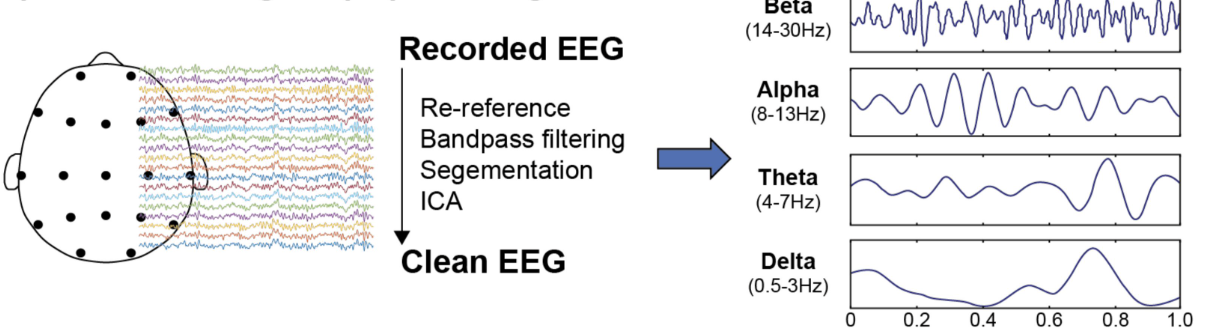
Bandpass filtering (1–50 Hz), Independent Component Analysis (ICA) for artifact removal, and 2-second epoching with 50% overlap.
Feature Extraction
Three neurophysiologically relevant feature types: Theta/Beta Ratio, Alpha Power (8–13 Hz), and Slow Wave Activity (<12.5 Hz).
Data Quality
Rigorous quality control including artifact detection, channel validation, and statistical outlier removal to ensure clean datasets.
Machine Learning Approach
We implemented and compared three traditional machine learning models, each chosen for their proven effectiveness in biomedical signal classification:
Support Vector Machine (SVM)
Linear and RBF kernels for both linear and non-linear pattern recognition, with hyperparameter optimization via grid search.
Random Forest
Ensemble method providing feature importance insights and robust performance across different feature types.
K-Nearest Neighbors (KNN)
Instance-based learning with optimized k-value selection and distance metric evaluation for local pattern recognition.
Model Validation
- Cross-Validation: 5-fold stratified cross-validation to ensure robust performance estimates
- Hyperparameter Tuning: Grid search optimization for each model's parameters
- Performance Metrics: Accuracy, precision, recall, and F1-score evaluation
- Statistical Significance: Multiple runs with different random seeds for statistical validation
Results & Performance Analysis
Key Performance Summary
Best Result: SVM with Theta/Beta Ratio features achieved 80.6% accuracy and 77% precision, demonstrating strong potential for clinical application. This performance significantly exceeds chance level (50%) and approaches clinically relevant thresholds.
Feature-Specific Results
Theta/Beta Ratio Classification (Best Performance)
| Model | Accuracy | Precision | Clinical Relevance |
|---|---|---|---|
| KNN | 73.2% | 75% | Good baseline performance |
| Random Forest | 77.3% | 71% | Strong feature importance insights |
| SVM | 80.6% | 77% | Best overall performance |
Alpha Power Classification
| Model | Accuracy | Precision | Performance Note |
|---|---|---|---|
| KNN | 63.0% | 60% | Moderate discriminative power |
| Random Forest | 60.6% | 54% | Lower performance on alpha features |
| SVM | 68.0% | 67% | Most consistent across features |
Slow Wave Activity Classification
| Model | Accuracy | Precision | Clinical Insights |
|---|---|---|---|
| KNN | 62.7% | 57% | Captures local neural patterns |
| Random Forest | 67.6% | 69% | Good precision for slow waves |
| SVM | 68.3% | 67% | Balanced classification performance |
Key Findings & Insights
Best Performance
SVM with Theta/Beta Ratio features achieved the highest accuracy (80.6%), demonstrating the clinical relevance of this biomarker.
Feature Ranking
Theta/Beta Ratio > Slow Wave Activity > Alpha Power in terms of discriminative power for ADHD classification.
Model Consistency
SVM demonstrated the most consistent performance across all feature types, making it the most reliable classifier.
Neural Signatures
Frontal and central EEG channels showed the highest discriminative power, aligning with neurobiological understanding of ADHD.
Clinical Significance
The 80.6% accuracy achieved with traditional machine learning models demonstrates that EEG-based biomarkers can effectively support ADHD diagnosis. This performance level approaches the reliability needed for clinical decision support tools, potentially reducing diagnostic subjectivity and improving access to objective assessment methods.
Tools & Technologies
Future Directions & Clinical Impact
Immediate Next Steps
- Feature Enhancement: Explore connectivity measures, nonlinear features, and time-frequency analysis for improved discrimination
- Deep Learning Integration: Compare traditional models with CNN, LSTM, and EEGNet architectures for potential performance gains
- Dataset Expansion: Address current limitations in dataset size and demographic diversity
Clinical Applications
- Diagnostic Support: Develop screening tools to supplement traditional behavioral assessments
- Treatment Monitoring: Track therapeutic response through EEG biomarker changes
Broader Impact
This research contributes to the development of objective, data-driven diagnostic tools for ADHD, potentially improving diagnostic accuracy and accessibility. The methodology can be extended to other neuropsychiatric conditions, advancing the field of computational psychiatry and precision medicine.